ZERENI

ZERENI
What if your mental-health app could understand
how you feel before deciding what you need?
ZERENI is an emotionally adaptive mental-wellbeing
companion designed to make everyday emotional
support feel more personal, approachable, and human.
Emotionally Adaptive UI · AI Companion ·
Mood Tracking · Journaling
Client
PERSONAL PROJECT
Services
PRODUCT DESIGN/UI/UX/UX RESEARCH
Year
2026

THE QUESTION
Why does emotional support still feel so one-size-fits-all?
Most wellbeing apps give users the same experience regardless of how they're feeling.
But emotional needs change.
Sometimes you want to talk.
Sometimes you need to slow down.
Sometimes you don't want advice at all.
So I asked:
What if the interface itself could adapt to the user's emotional state and respond accordingly?
THE PROBLEM
Mental wellbeing isn't one-size-fits-all.
People experience emotions differently, and what helps them can change from one moment to another.
Yet many wellbeing experiences rely on static routines, generic recommendations, and isolated tools for things like meditation, journaling, or mood tracking.
This creates a gap between:
How someone feels → What they actually need → What the product offers
Users may know they need support, but still struggle to understand what they need in that moment or where to begin.

BEFORE WE DESIGN, LET’S UNDERSTAND
WHAT PEOPLE FEEL.
Mental health is deeply personal. So instead of designing around assumptions,
I wanted to understand the emotions, struggles, and moments that shape how people seek support.
RESEARCH
Understanding how people experience emotional wellbeing
I explored how people understand their emotions, seek support, and use digital wellbeing tools.
The research focused on:
Emotional awareness
Coping behaviours
Existing wellbeing experiences
Personalisation
Consistency & engagement
The goal:
Understand what people actually need from a wellbeing experience.
RESEARCH FINDINGS
Emotional needs aren't static.
The research revealed five recurring patterns:
01: People don't always know what they need.
02: Context changes what kind of support feels
useful.
03: Tracking emotions can feel too clinical.
04: Maintaining wellbeing routines is difficult.
05: People want support that feels personal and
relevant.
EMPATHY MAP
Looking beyond what users say to understand what
they experience.
The empathy map helped me organise recurring
patterns from the interviews across what users think,
feel, say, and do.
It revealed a consistent tension: users often recognise
that something is wrong but struggle to understand
what they need, express it, or find support that feels
right in that moment.
These patterns became the foundation for defining
ZERENI’s personalised and emotionally responsive
experience.

KEY INSIGHTS
What the patterns told me:
01: People struggle to name what they feel.
Recognising an emotion doesn't always mean
understanding its cause or what to do next.
02: Support needs to feel personal.
Users respond differently depending on their emotional
state and context.
03: Emotional wellbeing shouldn't feel like another
task.
Rigid routines, reminders, and complicated tracking can
create friction instead of support.
04: Being heard can be as important as being helped.
Users often want space to express themselves before
receiving advice or an activity.
05: Reflection can turn moments into self-awareness.
Looking back at emotions and experiences can help
users recognise patterns over time.
THE PATTERNS STARTED TO FEEL PERSONAL.
Behind every insight was a different person, with different emotions, needs,
and ways of coping. So I turned those patterns into people I could design for.
THE PEOPLE
Meet the people behind the patterns.
I translated the recurring behaviours, motivations,
frustrations, and goals from the research into
representative user profiles.
The personas helped keep ZERENI grounded in real
emotional needs rather than assumptions, and gave
me a clearer lens for making product decisions
throughout the design process.

USER JOURNEY MAP
From recognising an emotion to understanding it.
The journey maps how a user moves through ZERENI
when they need emotional support, from the first moment
they notice something feels off to reflecting on their
experience.
NOTICE → CHECK IN → UNDERSTAND →
RESPOND → REFLECT
It helped identify where ZERENI could reduce friction
and provide more relevant, emotionally responsive
support.

JOBS TO BE DONE
When I feel emotionally overwhelmed or disconnected,
I want to understand what I'm experiencing and find the
kind of support I need in that moment, so I can feel
more in control of myself.
USER NEEDS
Users need a simple, personal, and emotionally
responsive way to understand what they're feeling
and find the right support in the moment.
THE RESEARCH ANSWERED “WHAT.”
NOW CAME THE “WHY.”
It was time to dig beneath the patterns and define the problem worth solving.
PROBLEM STATEMENTS
People often struggle to understand what they need
emotionally in the moment, while existing wellbeing
experiences can feel static, generic, and disconnected
from their changing emotional states.
DESIGN CHALLENGE
How might we create an emotionally adaptive wellbeing
experience that understands how users feel, responds
appropriately in the moment, and helps them build a
deeper understanding of themselves over time?
OPPORTUNITIES AREA
Turning emotional needs into design
opportunities
01: Adapt to the user's emotional state
Make support responsive to how the user feels in the
moment.
02: Make emotional expression easier
Give users a comfortable way to express what they're
experiencing without pressure.
03: Recommend the right support
Connect users with relevant activities instead of
presenting a one-size-fits-all library.
04: Make wellbeing feel effortless
Reduce friction so checking in, reflecting, and taking
care of yourself doesn't feel like another task.
05: Turn moments into self-awareness
Help users recognise emotional patterns and
understand themselves better over time.
SO, WHAT IF SUPPORT COULD MEET
PEOPLE WHERE THEY ARE?
Instead of asking people to adapt to one fixed experience, what if the experience adapted to them?
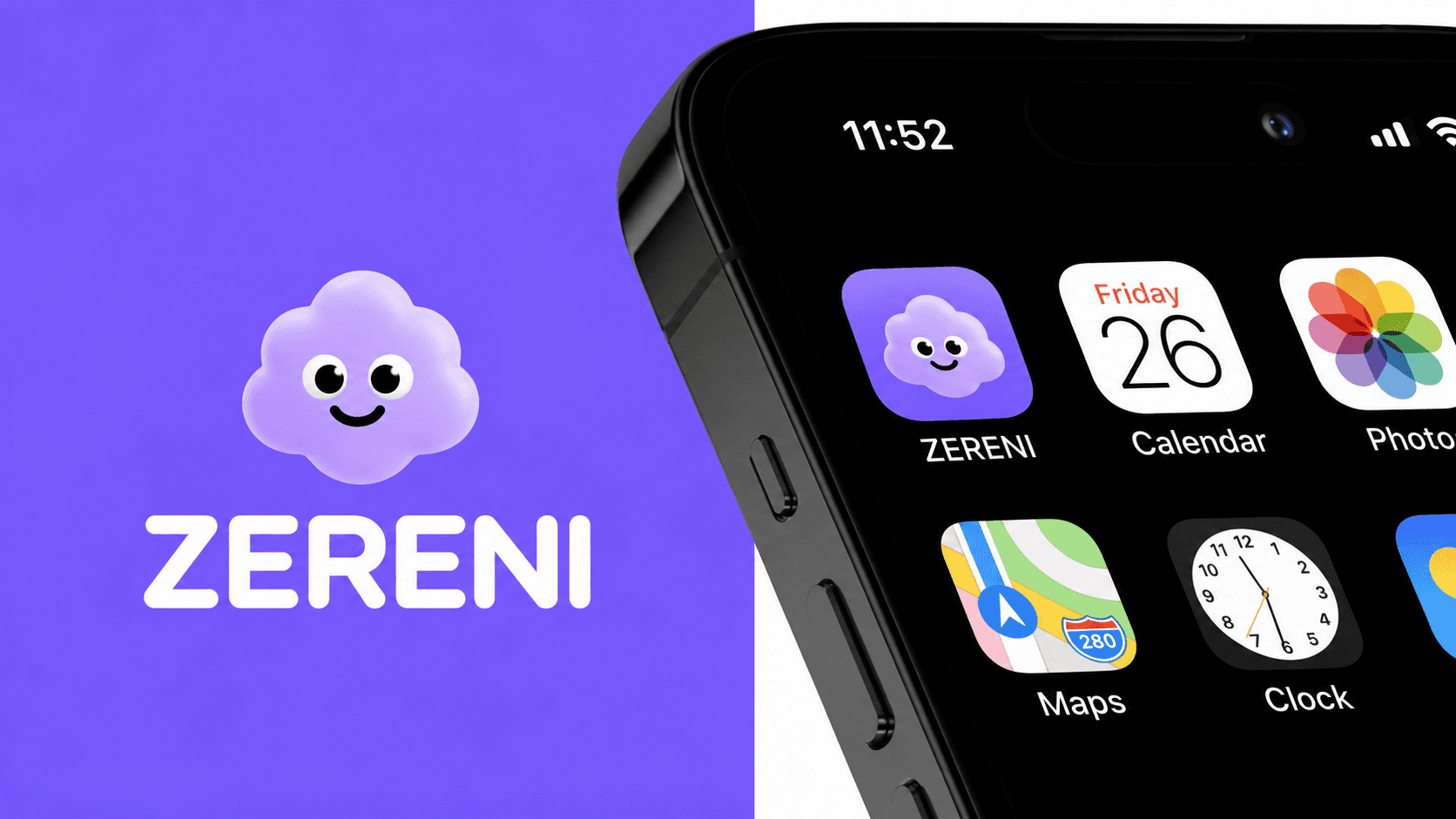
INTRODUCING
ZERENI
Live a life worth remembering
ZERENI is an emotionally adaptive mental-wellbeing companion designed to help users understand how they feel, find the right support in the moment, and build greater self-awareness over time.
Instead of giving everyone the same experience, ZERENI adapts through:
MOOD → CONTEXT → SUPPORT → REFLECTION
The core idea
Your emotions change. Your experience should too.
HOW ZERENI WORKS
From an emotion to the right kind of support.
01: CHECK IN
Tell ZERENI how you're feeling.
02: UNDERSTAND
Explore what's behind the emotion through gentle prompts and conversation.
03: CONNECT
Talk to Zeri, your AI companion, when you need a space to express yourself.
04: CARE
Receive relevant support through breathing, meditation, journaling, or other activities.
05: REFLECT
Track your emotional journey and recognise patterns over time.
CHECK IN → UNDERSTAND → CONNECT → CARE → REFLECT
ZERENI adapts the experience to the moment you're in.
THE PRODUCT SYSTEM
A space that adapts to how you feel.
Zereni brings emotional check-ins, personalized support, reflection, and calming activities into one connected experience.
MOOD CHECK-IN
Understand how you’re feeling in the moment.
AI BUDDY
A conversational space to express yourself and receive personalized support.
MOOD JOURNEY
Track emotional patterns over time and understand how your moods evolve.
JOURNAL
A private space to reflect, write, and process your thoughts.
BREATHE & MEDITATE
Short guided exercises for moments when you need to slow down and reset.
ZERENI
A friendly companion that makes the experience feel less clinical and more human.
The core idea
Your mood shapes the experience.
Zereni connects what you feel with what the product offers next, making the experience feel more personal instead of one-size-fits-all.
INFORMATION ARCHITECTURE
ZERENI's information architecture keeps emotional support, reflection, and self-awareness within easy reach through five simple primary navigation areas.

FROM STRUCTURE TO EXPERIENCE.
Now, let’s see how a user actually moves through Zereni.
USER JOURNEY FLOW
The user journey follows a simple loop:
check in → understand → receive support → reflect
allowing ZERENI to adapt to the user's emotional state without adding friction.

WIREFRAMES
I first mapped ZERENI's core interactions through low-fidelity wireframes, focusing on structure, hierarchy, and flow before moving into visual design.
VISUAL LANGUAGE
Soft, playful, and emotionally comforting.
Lavender tones, rounded UI, friendly typography, and expressive Zeri illustrations create a warm, approachable wellbeing experience.
Making mental wellbeing feel less clinical and more human.

NOW, LET’S BRING THE SYSTEM TO LIFE.
Every insight, decision, and interaction comes together in the final Zereni experience.
FINAL UI
The final UI brings ZERENI's research, adaptive experience, and visual language together into one cohesive product.
Home · AI Buddy · Journal · Mood · Profile
Designed to make emotional support feel personal, simple, and human.

PROTOTYPE
The prototype connected ZERENI's key screens into one seamless flow, allowing me to test navigation, interactions, and the emotional journey from check-in to support and reflection.
From individual screens to one connected experience.
WHAT STARTED AS A QUESTION, NOW HAD AN ANSWER.
Zereni took shape through every insight, iteration, and design decision.
OUTCOME
From a mood tracker to an emotionally adaptive experience.
ZERENI brings mood awareness, AI companionship, reflection, and personalised support into one connected experience.
A wellbeing experience designed to meet users where they are.
LEARNINGS & REFLECTIONS
Designing ZERENI taught me to design for emotional context, not just functionality.
Throughout the process, I learned that a wellbeing product isn't simply about adding more features. Every interaction needs to respond to what the user is experiencing in that moment.
01: Research changes the direction
Talking to users helped me move beyond assumptions and design around real emotional needs.
02: Personalisation needs purpose
Making an experience adaptive isn't about adding complexity. It's about making the right support easier to find.
03: Simplicity matters more than feature count
When someone is already overwhelmed, the product shouldn't become another thing they have to figure out.
04: Features need to work as one system
Mood tracking, Zeri, journaling, and breathing exercises became more meaningful when connected through one continuous experience.
05: Design can create space, not just solutions
Sometimes the most useful thing a product can do is give someone a place to pause, express themselves, and understand what's happening.
MY BIGGEST TAKEAWAY
Good personalisation isn't just knowing the user. It's understanding what they might need right now.
THE END
You don't have to figure everything out at once.
Sometimes, understanding how you feel is the first step toward feeling better.
ZERENI